Crowns and bridges are common dental restorations used to repair or replace damaged or missing teeth.
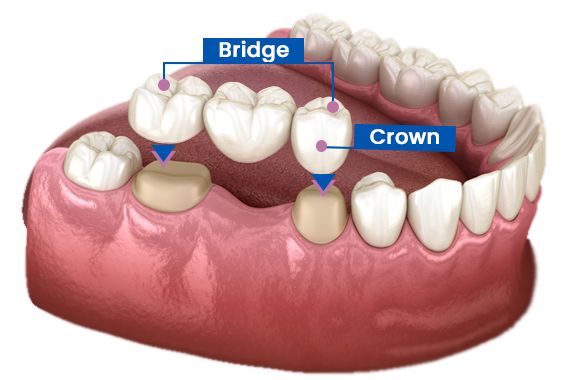
A dental crown, often called a “cap,” is a custom-made restoration that covers the entire visible portion of a tooth.
It restores the tooth’s shape, size, strength, and appearance.
Crowns can be made from various materials, including porcelain, ceramic, metal alloys, or a combination
To protect a weak tooth from fracture or to hold together parts of a cracked tooth.
To restore a broken or heavily worn-down tooth.
To cover and support a tooth with a large filling when there isn’t enough tooth structure remaining.
To cover a dental implant.
To hold a dental bridge in place.
To cover discolored or poorly shaped teeth.
To cover a tooth that has had root canal treatment.
Examination and Preparation: The dentist examines the tooth and takes X-rays. If there’s significant decay or a risk of infection, a root canal might be needed first. The tooth is then filed down to create space for the crown.
Impressions: An impression (mold) of the tooth is taken. This is sent to a dental lab, which fabricates the custom crown.
Temporary Crown: A temporary crown is placed to protect the prepared tooth while the permanent crown is being made.
Permanent Crown Placement: Once the permanent crown is ready, the temporary crown is removed, and the new crown is fitted and cemented onto the tooth.
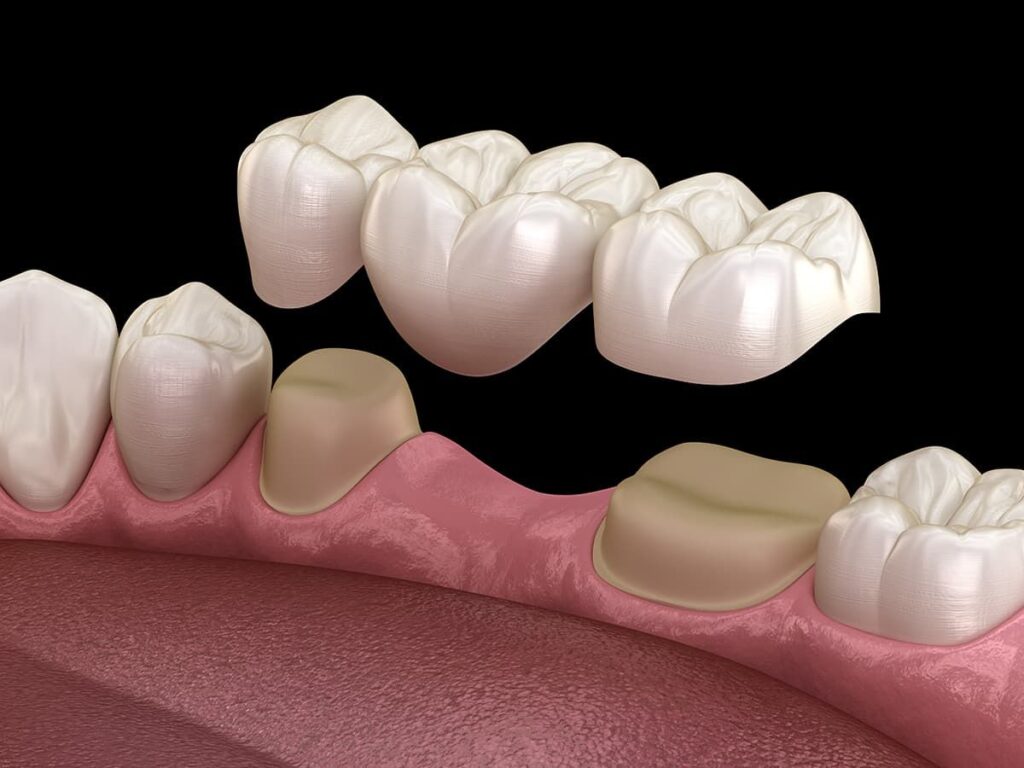
A dental bridge is a restoration used to replace one or more missing teeth.
It consists of one or more artificial teeth (pontics) held in place by crowns on the adjacent teeth (abutment teeth). Like crowns, bridges can be made from porcelain, ceramic, metal alloys, or a combination.
To fill the gap caused by missing teeth.
To prevent remaining teeth from shifting out of position.
To restore chewing and speaking ability.
To maintain the shape of the face.
To distribute bite forces properly.
Preparation of Abutment Teeth: The teeth adjacent to the gap are prepared for crowns, similar to the crown procedure.
Impressions: An impression is taken to create the bridge, ensuring it fits precisely and matches the surrounding teeth.
Temporary Bridge: A temporary bridge is placed to protect the prepared teeth and maintain the space while the permanent bridge is being made.
Permanent Bridge Placement: The temporary bridge is removed, and the permanent bridge is fitted and cemented onto the abutment teeth.
Traditional Bridges: The most common type, involving a pontic supported by crowns on adjacent teeth.
Cantilever Bridges: Used when there are adjacent teeth on only one side of the missing tooth.
Maryland Bridges (Resin-Bonded Bridges): Have a metal or porcelain framework that is bonded to the back of the adjacent teeth. They require less preparation of the abutment teeth.
Implant-Supported Bridges: Used when several teeth are missing. The bridge is supported by dental implants rather than natural teeth.
Restored Function: Improve chewing and speaking abilities.
Enhanced Appearance: Provide a natural-looking smile.
Prevent Shifting: Keep remaining teeth from moving out of place.
Support Facial Structures: Help maintain the shape of the face
.
Long-Lasting: Can last many years with proper care.
Good Oral Hygiene: Brush and floss daily, paying special attention to the area around the crown or bridge.
Regular Dental Checkups: Visit your dentist regularly for professional cleanings and examinations.
Dietary Considerations: Avoid chewing hard or sticky foods that could damage the crown or bridge.
Proper Cleaning Techniques: Use floss threaders or interdental brushes to clean under the pontic of a bridge.